¶ What Happens When a BoxHouse Is Sold
The short version: When a home is marked Sold in Salesforce and its down payment is received, two automations take over. One creates the matching Sales Order in NetSuite so no one re-keys it. The other tracks every CUSTOMER DEPOSIT against that home and keeps a live balance owed on the record. Salesforce runs the sale and the process; NetSuite holds the books.
This page follows the life of a sale from the moment it closes through the systems it touches. It's written to be read by anyone on the team — Sales, Finance, or Tech — with a technical appendix at the bottom for whoever maintains the integrations.
¶ THE FLOW AT A GLANCE
The down payment is the hinge. The date the down payment is received is what arms the Sales Order automation, and the wires that make up that down payment are what the balance tracker logs. One event drives both halves of this page.
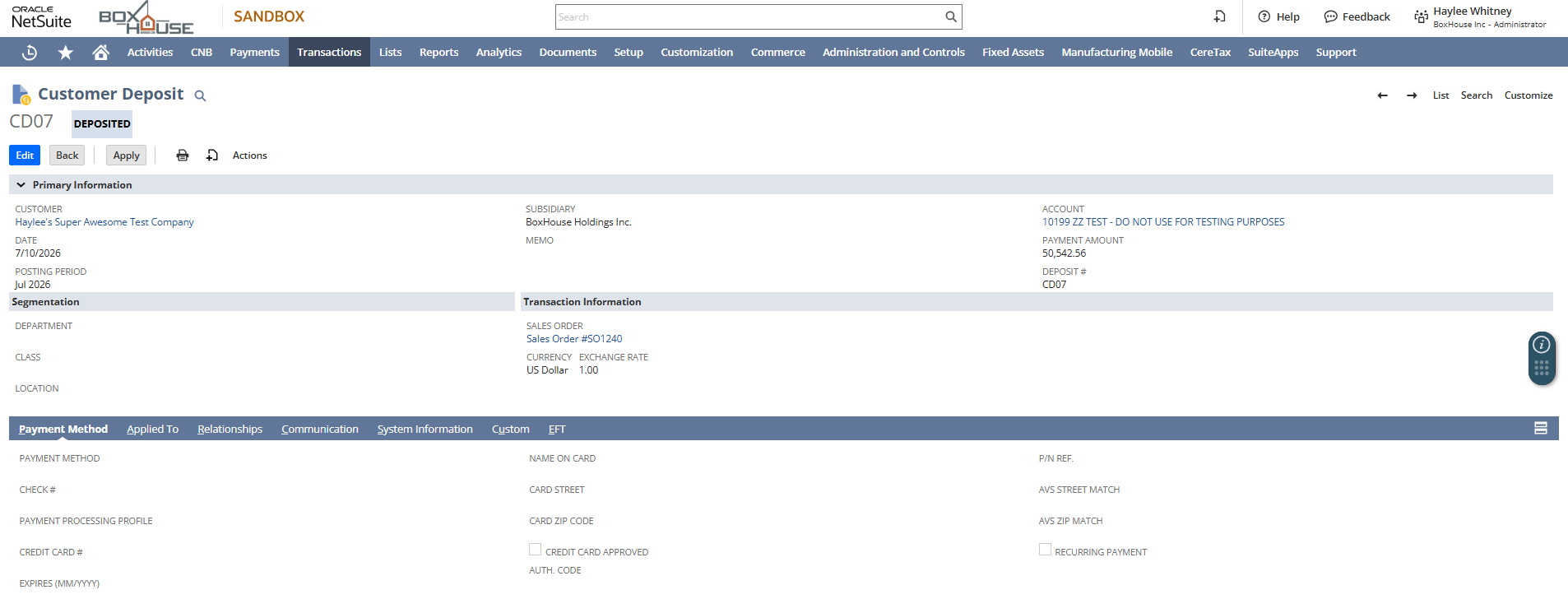
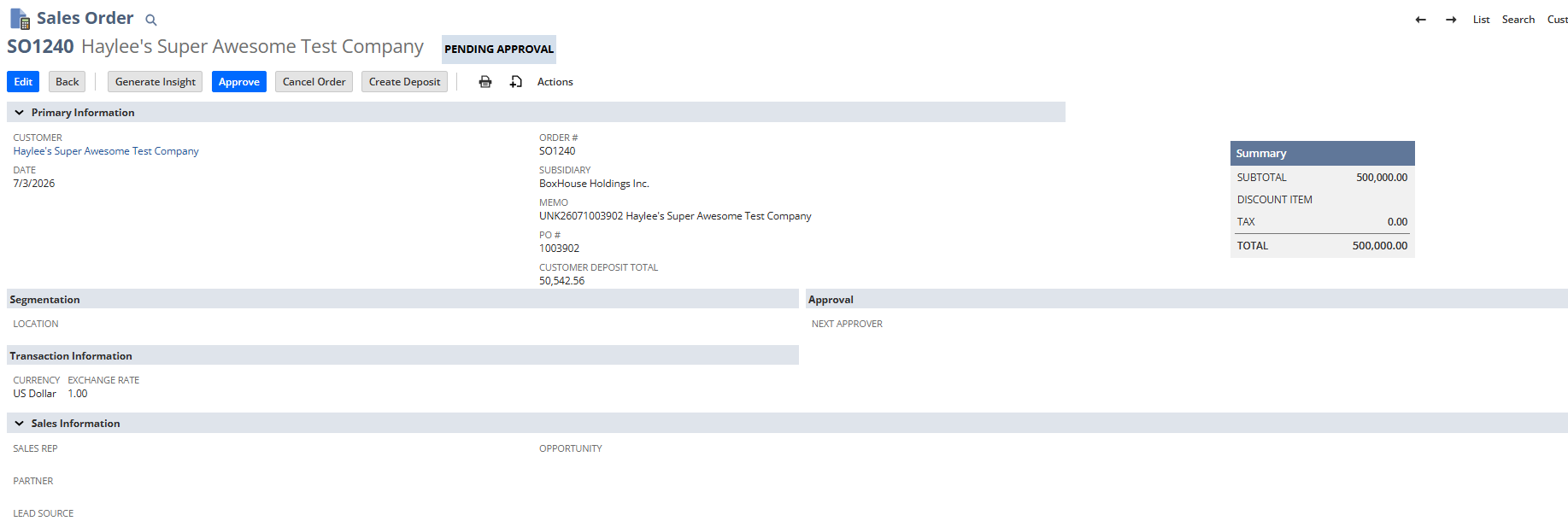
Follow one real sale: This page uses one live example — the Salesforce record #1003902 and its customer deposit CD07
*
¶ 1 · IT STARTS WITH A SALE
Every home we sell lives as a BoxHouse record in Salesforce — the BoxHouses__c custom object. It's the single record for that sold home, and it's what both automations read from.
Two things have to be true before anything downstream runs:
- Status =
Sold, and - Down Payment Received Date is filled in.
A sold home with no down-payment date just waits — that's the safe default (no date, no sync). Today that date is entered by hand (Landon) as payments are verified; eventually his app will write it automatically.
The fields that do the work:
| Field | API name | What it drives |
|---|---|---|
| Status | Status__c |
Must equal Sold. Part of the trigger. |
| Down Payment Received Date | Down_Payment_Received_Date__c |
Arms the automation, and becomes the NetSuite transaction date. |
| NetSuite Sales Order | Netsuite_Sales_Order__c |
Must be blank to fire (stops duplicates); the SO# is written back here. |
| Purchase Price | Purchase_Price__c |
The price that flows onto the Sales Order line. |
| Account | Account__c |
The customer, used to find (or create) the matching NetSuite customer. |
| Down Payment | Down_Payment__c |
The agreed down-payment total the balance counts down from. |
| Administration Fee | Administration_Fee__c |
Added to the down payment to form the total the balance counts down from. |
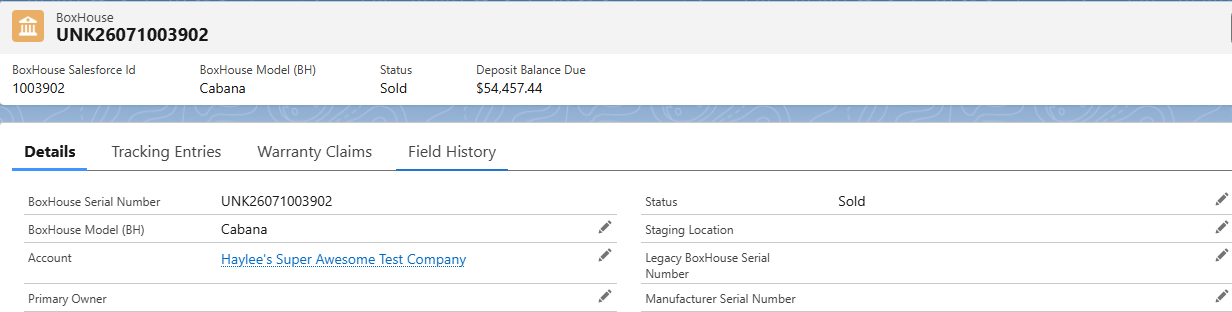
Example — record #1003902, marked Sold:
¶ 2 · STAGE 1 — Sales Order Automation (Salesforce → NetSuite)
The problem it solves: we used to enter every sale twice — once in Salesforce, again in NetSuite. This kills the double-entry. One qualifying BoxHouse record becomes exactly one Sales Order in NetSuite, automatically, with the SO number linked back to Salesforce.
It runs in n8n (workflow SalesForce SO to Netsuite SO, ~37 nodes) and talks to NetSuite over its REST API using token-based authentication.
¶ What Fires It
An n8n polling trigger watches BoxHouses__c for changes. Because the trigger only hands over the record's Id, the first step re-reads the full record, and a Filter then checks all three gates together:
Status__c = SoldANDDown_Payment_Received_Date__cis populated ANDNetsuite_Sales_Order__cis blank
That last condition is the duplicate guard — once a record has an SO number, it can never fire again.
¶ One Path Today: Direct
Every sale is currently processed as a Direct sale (billed to the actual customer). The separate Tax Sale route — which would bill a finance company instead — is built but parked until leadership picks a finance partner; turning it back on is a one-connection change, so no work is lost.
¶ Finding (or Creating) the Customer
NetSuite needs the customer's internal ID before it will accept an order — and that's not the "Customer ID" you see on screen (that's the name). So the flow:
- Searches NetSuite for a customer whose name matches the Salesforce Account. The match is deliberately forgiving — differences in apostrophes or extra spaces between the two systems won't break it.
- Found → uses that customer's internal ID and reads the subsidiary off their own record (not hardcoded), so multi-subsidiary sales land correctly.
- Not found → creates a new individual customer. This create step is guarded and stays off until a configuration value is set; until then, an unmatched customer is routed to the error log rather than guessed at.
¶ Price
The Sales Order line price comes from Purchase_Price__c. A "Has Price?" guard sits in the middle of the flow: a real price continues; a blank or $0 price is stopped and logged (see below) so we never push a valueless order into NetSuite.
¶ What Lands on the Sales Order
| NetSuite field | Comes from |
|---|---|
Customer (entity) |
The looked-up / created customer's internal ID |
| Subsidiary | Read off that customer's record |
Transaction date (tranDate) |
Down_Payment_Received_Date__c (cash-basis timing) |
| Memo | Serial number + customer name |
| Line price | Purchase_Price__c |
| Line item | Currently a single placeholder item — see status below |
Documentation Link (custbody1) |
A hyperlink back to the BoxHouse record in Salesforce |
¶ Linking Back to Salesforce
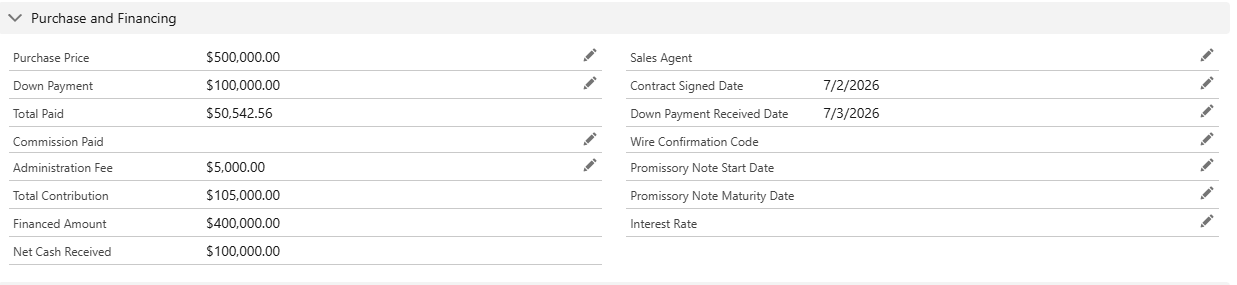
NetSuite's create call only returns an internal ID, so the flow then reads the order back to get its human-readable SO number (e.g. SO1240) and writes that into Netsuite_Sales_Order__c on the BoxHouse record — closing the loop between the two systems.
¶ When Something's Wrong
Records that can't proceed — no price, or a customer that can't be resolved — aren't dropped silently. They're logged as a task in the central ClickUp Error Messages Log (silent, assigned to the integrations owner) so they can be fixed and re-run.
¶ Worked Example
Sandbox test record #1003902 ($500K sale): passed all three gates → matched its customer in NetSuite → created SO1240 for $500,000, transaction-dated from the down-payment date, memo = serial + name → SO number written back onto the Salesforce record.
¶ 3 · STAGE 2 — Down-payment Balance Tracking (Salesforce)
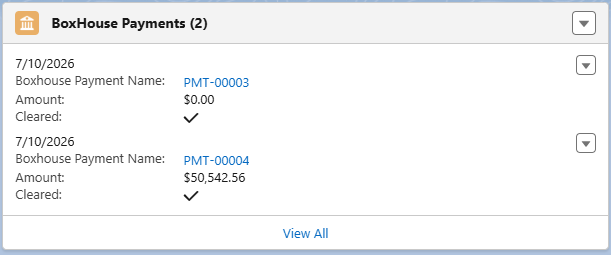
The problem it solves: a down payment (say $100K on a $500K home) arrives as several irregular wires — $10K here, $50K there. Until now there was nowhere on the record to see how much a customer still owed when they called in; Charity reconciled the bank in a spreadsheet and Landon re-keyed it into Salesforce. This makes the balance live on the record and kills the spreadsheet.
It lives entirely in Salesforce — no n8n involved — because the balance is just math on data already landing on the record.
¶ How It's Built
Each wire is its own Payment record (BoxHouse_Payment__c, auto-numbered PMT-00001…), attached to its BoxHouse as a master-detail child. Child records were chosen over a single running-total field on purpose: they mirror Charity's spreadsheet row-for-row, keep a full audit trail for Accounting, and mean Landon never does the math himself.
Each payment carries:
| Field | API name | Type | Notes |
|---|---|---|---|
| Amount | Amount__c |
Currency | Required |
| Payment Date | Payment_Date__c |
Date | Required |
| Payment Type | Payment_Type__c |
Picklist | Down Payment / Other |
| Method | Method__c |
Picklist | Wire / Check |
| Confirmation Code | Confirmation_Code__c |
Text | Moves to the payment (was record-level) |
| Cleared | Cleared__c |
Checkbox | Only cleared rows count |
¶ The Math (on the Parent Record)
Two calculated fields on the BoxHouse record update themselves as wires come in and clear:
Down_Payment_Paid__c— a roll-up that sums the Amount of every payment where Type = Down Payment and Cleared = true.Down_Payment_Balance__c— a formula: Down Payment + Administration Fee − Down Payment Paid (BLANKVALUE(Down_Payment__c,0) + BLANKVALUE(Administration_Fee__c,0) − Down_Payment_Paid__c). The customer owes both the down payment and the administration fee, so the balance counts down from the two combined.
Because only cleared payments count, the balance reflects money actually in hand — not just promised. It counts down from the down payment plus the administration fee (
Administration_Fee__c). Bridger has discussed adding a licensing fee as well, but no decision has been made yet.

¶ 4 · Status & What's Next
| Piece | Where it is | To go live |
|---|---|---|
| Sales Order automation (TECH-419) | Validated in sandbox; deactivated | Adam: publish + production credentials/URLs. Bridger: SKU crosswalk. |
| Down-payment tracking (TECH-625) | Validated in sandbox | Adam: production cutover — targeted next week |
| Tax Sale route | Built, parked | Leadership picks a finance partner (one-connection re-enable) |
| Down-payment date auto-fill | Manual entry today | Landon's app writing the date in production |
¶ Quick Reference
| Term | Plain English |
|---|---|
BoxHouse record (BoxHouses__c) |
The Salesforce record for one sold home. The source of everything here. |
| The trigger | Sold and a down-payment date and no SO number yet. |
| Sales Order automation | The n8n workflow that turns a qualifying record into a NetSuite Sales Order. |
| Direct sale | The sale type processed today; the customer is billed directly. Tax Sale is parked. |
SO# writeback (Netsuite_Sales_Order__c) |
The NetSuite order number written back onto the Salesforce record; also the duplicate guard. |
Payment record (BoxHouse_Payment__c) |
One down-payment wire attached to a BoxHouse. |
Cleared (Cleared__c) |
The checkbox that makes a payment count toward the balance. |
Down Payment Paid (Down_Payment_Paid__c) |
Sum of all cleared down-payment wires on a home. |
Down Payment Balance (Down_Payment_Balance__c) |
Down Payment − Down Payment Paid. The live "still owes" figure. |
| Error Messages Log | The ClickUp list where blocked records (no price, no customer) land for fixing. |
| SKU crosswalk | The mapping from a BoxHouse model/variation to its NetSuite item. Needed before multi-model go-live. |
Salesforce runs the sale and the process. NetSuite holds the books. The sale flows from one to the other — automatically, and on the record.